
Learn about the impact of outdoor cats on birds and wildlife in Canada and the US. Each year, millions of birds, reptiles, and amphibians are killed by free-roaming cats, contributing to population declines. Discover strategies like using bright collars or bibs, or walking cats on leashes to help protect native species. Explore NatureKids BC’s Bird Aware Cat Care project, which educates youth about conservation through citizen science. Watch videos and read reports to find ways to reduce these impacts while letting cats go outside safely.
Cats can be harmful to the environment
Canada’s bird populations are in trouble; some species have declined by more than 90%. These declines are mainly due to habitat destruction, climate change and invasive species (including cats). It has been estimated that free-roaming cats cause approximately 200 million bird deaths each year in Canada alone. Not only that but it’s estimated that cats kill over 480 million reptiles and 180 million amphibians in the US each year too. Although the ideal approach is to keep cats indoors, we have provided information on tools and strategies to help reduce bird, lizard, and amphibian mortality for those cats that will continue to go outdoors.
Citizen Science
Citizen science (crowdsourcing conservation data by the general public) is becoming increasingly popular. It has been shown to be an effective way to help youth learn about the environment, have a conservation impact and connect them to their community – all while being outdoors.
In 2018 NatureKids BC finished its two-year-long Bird Aware Cat Care Youth Citizen Science Project. It’s part of a national effort led by Nature Canada called “Keep Cats Safe & Save Bird Lives” of which NatureKids BC is an official partner. This project involved a public awareness campaign and an experiment to test different bird-catching deterrents (such as bird collars and leashes).
Key takeaways from this project were:
• Some of our experiment volunteers were concerned about their cat’s safety when using the predator deterrent devices.
→ Education campaigns should encourage cat owners to train their cats to wear and tolerate a collar and other devices, starting when the cat is young.
→ Clear instructions need to be included with each predator deterrent device.
→ Equipment users also need to be encouraged to allow for a longer adaptation period for them and their cats regarding the various devices before use outdoors or before they give up on them (e.g., use the device on the cat only when it is indoors until the animal is comfortable)
• If we compare dog ownership to cat ownership there is a clear hypocrisy between the two.
→ Society has deemed it unacceptable to allow dogs to roam freely / unsupervised through the neighbourhood, especially in urban environments.
→ Until municipal by-laws come into place, and are enforced, that make it illegal to allow cats to roam freely, people will continue to do it.
•Given the extensive list of techniques and devices now available to cat owners, there is no excuse for negligent cat ownership in terms of cat and bird safety.
→ Just like dogs, cats can go outside, but it may be harmful to allow them to roam freely. Beliefs and values are deeply entrenched.
→ It will take generations, and the installation and enforcement of by-laws, to change attitudes and behaviours.
→ Working with youth is an important strategy for changing how future generations will care for their pet cats and protect wild birds.
Solutions
Even if you don’t want to have an indoor cat, there are lots of options to help reduce your cat’s predation of native species. Different types of predation-deterrents you can use for your cats:
1) A brightly coloured collar (from BirdsBeSafe collar – http://www.birdsbesafe.com/ )
2) A collar bib (from CatBib – https://catgoods.com/order-catbib/)
3) Walk cats on a harness and leash versus free-roaming
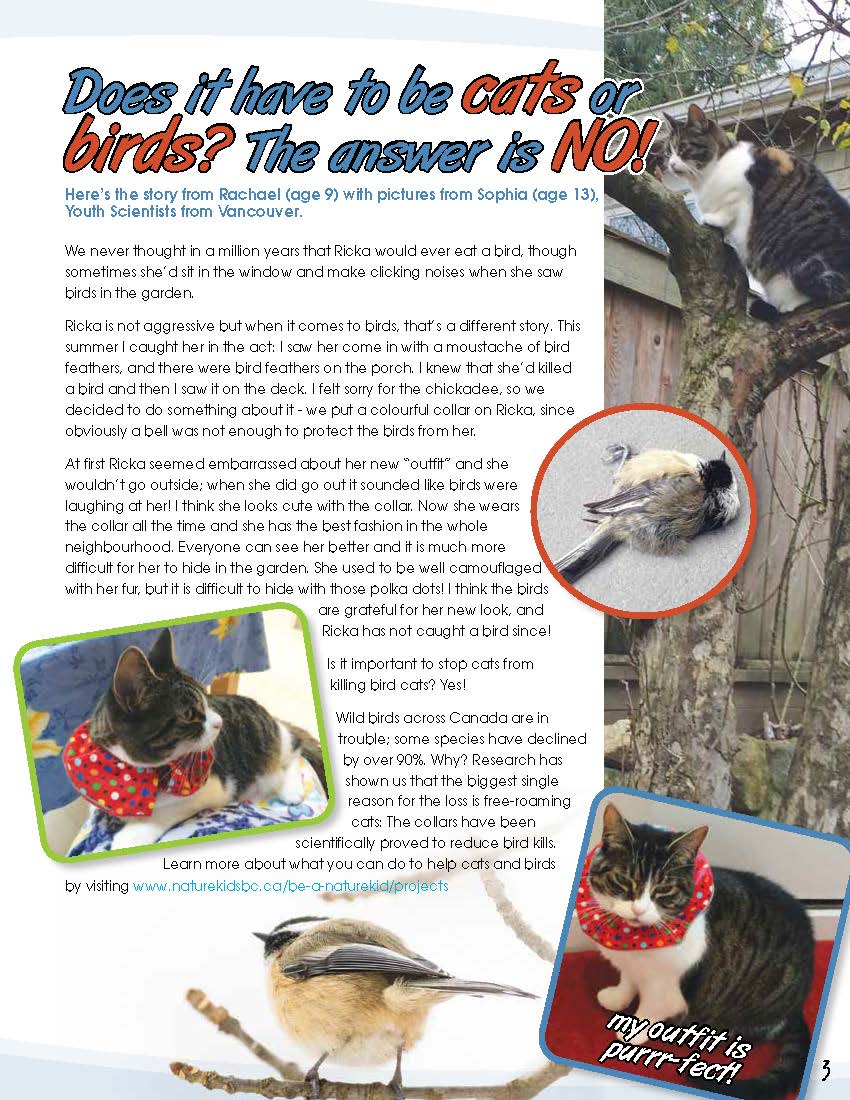
Read more about what we learned in our final project report, read a story published in NatureWILD magazine written by one of our junior scientists and watch our educational video below.
Video Resources
Educational video produced by NatureKids BC:
Video produced by Shaw North Island featuring NatureKids Bc’s Executive Director, Louise Pedersen:
Training videos:
This project was undertaken with the support of the Government of Canada, the Vancouver Foundation, the Gosling Foundation and HCTF.