• Who We Are
    • Our Team
      • Leaders’ Backroom
    • Our Commitment to Equitable Access and Inclusion
    • Our Principles for Relationship Building with Indigenous Peoples
    • Our Supporters
    • Our Blog
  • What We Do
    • Programming
      • Explorer Days
      • NatureWILD Magazine
      • Passport to Nature
      • Nature for Newcomers
      • NatureHood
      • EcoParent
    • Educational Resources
      • Kids Corner
    • Publications
  • Get Involved
    • Upcoming Events
    • Become a Member
    • Volunteer
      • Volunteer Stories
    • Donate
    • iNaturalist Project
    • Find a Nature Club
      • Start Your Own
  • NatureWILD
  • Shop
  • Who We Are
    • Our Team
      • Leaders’ Backroom
    • Our Commitment to Equitable Access and Inclusion
    • Our Principles for Relationship Building with Indigenous Peoples
    • Our Supporters
    • Our Blog
  • What We Do
    • Programming
      • Explorer Days
      • NatureWILD Magazine
      • Passport to Nature
      • Nature for Newcomers
      • NatureHood
      • EcoParent
    • Educational Resources
      • Kids Corner
    • Publications
  • Get Involved
    • Upcoming Events
    • Become a Member
    • Volunteer
      • Volunteer Stories
    • Donate
    • iNaturalist Project
    • Find a Nature Club
      • Start Your Own
  • NatureWILD
  • Shop
$0.00 0 Cart
Donate Now

Bird Aware Cat Care

Citizen science – which is crowdsourcing of conservation data by the general public – is becoming increasingly popular, and has been shown to be an effective way to help youth learn about the environment, have a conservation impact and connect them to their community – all while being outdoors.

NatureKids BC recently finished its two-year long Bird Aware Cat Care Youth Citizen Science Project. It’s part of a national effort led by Nature Canada called “Keep Cats Safe & Save Bird Lives” of which NatureKids BC is an official partner.

Canada’s bird populations are in trouble; some species have declined by more than 90%. These declines are mainly due to habitat destruction and climate change, and it’s estimated that free-roaming cats cause approximately 200 million bird deaths each year. Although the ideal approach is to keep cats indoors, we have provided information on tools and strategies to help reduce bird mortality for those cats that will continue to go outdoors.

Our observations and recommendations include:
  • Some of our experiment volunteers were concerned about their cat’s safety when using the predator deterrent devices. Education campaigns needs to encourage cat owners to train their cats in wearing and tolerating a collar and other devices, starting when the cat is young. Clear instructions need to be included with each predator deterrent device. Equipment users also need to be encouraged to allow for a longer adaptation period for them and their cats regarding the various devices before use outdoors or before they give up on them (e.g., use the device on the cat only when it is indoors, until the animal is comfortable)
  • If we compare dog ownership to cat ownership it is obvious that there is a hypocrisy between the two. Society has deemed it unacceptable to allow dogs to roam freely / unsupervised through the neighbourhood, especially in urban environments. Until municipal by-laws come into place, and are enforced, that make it illegal to allow cats to roam freely, people will continue to do it.
  • Given the extensive list of techniques and devices that are now available to cat owners, there is no longer any excuse for negligent cat ownership in terms of cat and bird safety. Just like dogs, cats can go outside, but it is unacceptable to allow them to roam freely. Beliefs and values are deeply entrenched. It will take generations, and the instillation and enforcement of by-laws, to change attitudes and behaviours. Working with youth is an important strategy for changing how future generations will care for their pet cats and protect wild birds.
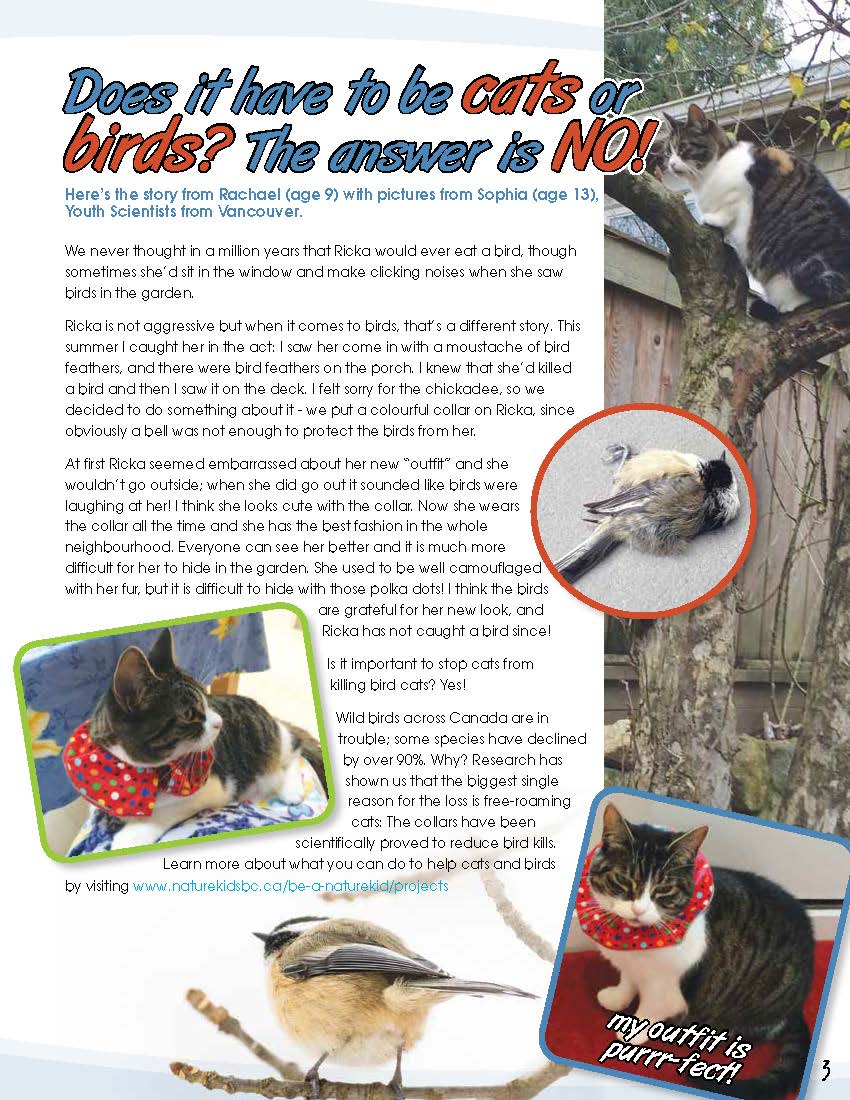
Read more about what we learned in our final project report, read a story published in NatureWILD magazine written by one of our junior scientists and watch our educational video below.

Educational video produced by NatureKids BC:

Video produced by Shaw North Island featuring NatureKids Bc’s Executive Director, Louise Pedersen:

Training videos:

  • Introduction
  • Doing the experiment

This project was undertaken with the support of the Government of Canada, the Vancouver Foundation, the Gosling Foundation and HCTF.

1620 Mt. Seymour Rd.
North Vancouver, BC V7G 2R9

604-985-3059
info@naturekidsbc.ca
Facebook Youtube Instagram

Get Involved

  • Donate
  • Become a member
  • Subscribe
  • Volunteer
  • Shop
  • Careers

Shortcuts

 
  • Privacy Policy

Mission

NatureKids BC helps children get outdoors to explore, play, learn about and take action for nature.

NatureKids BC is a registered charity (CRA # 84961 1926 RR0001) and our legal name is Young Naturalists’ Club of BC Society.

Join Our Community!

Naturekids BUZZ is a monthly e-newsletter delivering all of the latest news, stories and resources right to your inbox!

We gratefully acknowledge NatureKids BC offices being located in the Elders Council for Parks in BC Heritage Centre, on the traditional and unceded territory of the (Tsleil-Waututh), Skwxwú7mesh (Squamish), and S’ólh Téméxw (Stó:lo- ) nations. Similarly, we acknowledge that as a provincial network within many communities throughout British Columbia, our network learns and plays upon many different territories of the Indigenous Peoples of BC; we invite our local leaders to acknowledge the connection to local Indigenous communities of the ecosystem and place where we are honoured to learn and grow.

© 2024 NatureKidsBC. All rights reserved.